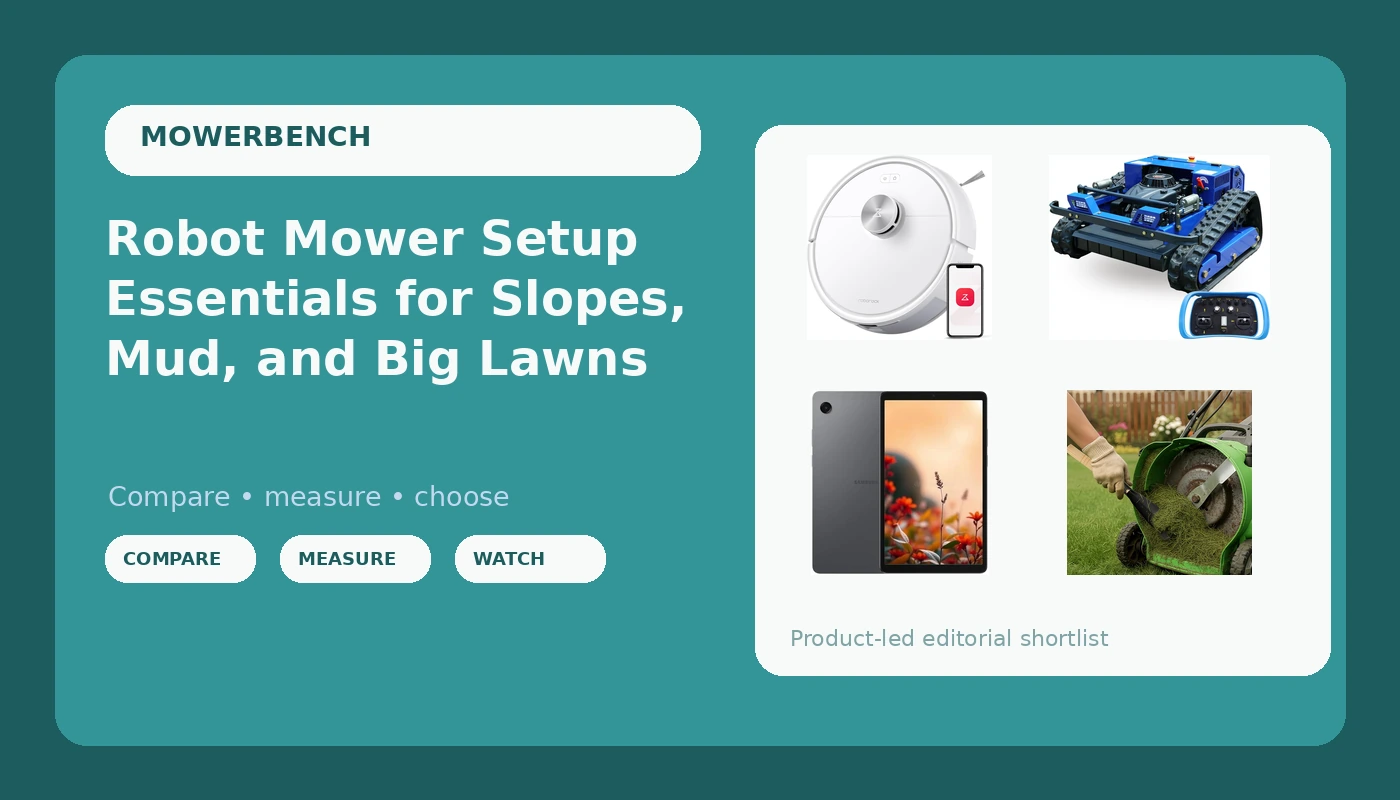
Most people shopping for a robot mower are shopping for one box, and that is exactly why install day goes sideways. A robot mower setup is a system: the machine, the boundary it follows, the ground it has to hold, the screen that schedules it, and the cleanup that happens afterward. I have installed more than thirty of these for clients around Minneapolis, and the pattern never changes. The mower gets all the attention and the supporting pieces get ignored, right up until the first week of mud.
This piece covers the robot mower setup essentials that live around the machine rather than inside it. Four items handle the parts of the job a mower cannot do alone: a tracked, remote controlled machine for ground a robot will not hold, a robot vacuum for what follows you back inside, a tablet that keeps the app off your phone, and a scraper that keeps the deck and blades in cutting condition. None of them replace a robot mower. Each one removes a specific reason people quit on one.
Related: What Perimeter Wire Really Costs on a Quarter Acre →
Quick answer
No single purchase covers a whole robot mower setup, and any list that claims otherwise is selling you one product. The mower is one line item; the system around it is several. If your lawn has a bank steeper than the mower can genuinely hold, a tracked remote controlled machine is what does that job instead. If your problem is scheduling and lost maps, the fix is usually a dedicated screen and a better boundary, not a new mower. If your problem is grass, grit, and dog hair tracked inside after every install and blade change, a robot vacuum handles that half of the work. And if the mower is tearing grass instead of cutting it, the answer is almost always a caked deck and dull blades, not a new machine.
Four useful options
| Model | Best fit | What stands out |
|---|---|---|
| AIWEIYA Remote Control Lawn Mower | Steep banks and large turf a robot mower cannot hold | Oil-electric hybrid crawler track drive, listed 1.1 to 5.9 inch cutting height, listing states 100% (45 degree) slope capability |
| roborock Q7 M5 Robot Vacuum and Mop Combo | Indoor cleanup after install day, blade changes, and muddy seasons | Vacuum and mop combo with 10,000Pa HyperForce suction as stated in the listing |
| Samsung Galaxy Tab A11 WiFi Model (International Version) | A dedicated screen for mower apps, maps, and schedules | 8.7 inch display, 64GB storage with 4GB memory, model number SM-X133, gray |
| Lawn Mower Deck Scraper Cleaning Hand Shovel | Deck maintenance and garden cleanup between cuts | Heavy duty metal construction with an ergonomic handle |
The slope machine: AIWEIYA Remote Control Lawn Mower
Understand what this is before you buy it: an operator runs it. There is no boundary wire, no schedule, no dock. That sounds like a downgrade until you stand at the bottom of a bank that a wheeled robot slides down sideways in wet grass. Tracks put more contact patch on the ground than wheels do, and the hybrid drivetrain is aimed at sustained load rather than a short run around a flat yard. The listed 1.1 to 5.9 inch range also overlaps with the height you would leave a rough bank at, which is where most robot mowers stop being useful. Treat the 45 degree figure as a dry-turf best case and de-rate it in your head for a wet Minnesota spring. The real question is whether you want to walk a bank with a remote in your hand, and for a lot of properties the honest answer is yes, once a week, rather than never.
The indoor half: roborock Q7 M5 Robot Vacuum and Mop Combo
Every client who has ever told me their robot mower was a mistake has also told me, in the same breath, that they were tired of grass clippings in the mudroom. That is not the mower's fault and no mower upgrade fixes it. The indoor half of a lawn system is unglamorous: a robot vacuum that runs on a schedule you never think about. A combo unit does the dry pickup and the damp wipe in one pass, which matters in a hallway where dog paws and grit arrive together. The scheduling logic is the same discipline the mower needs, which is a small hidden benefit: if you can keep a vacuum running daily, you can keep a mower running daily, and mowing frequency beats mower quality every single time.
The dedicated screen: Samsung Galaxy Tab A11 WiFi Model
Here is the argument for a second screen. The app is a feature, not the mower, and if scheduling fails the robot is a very slow Roomba. Mower apps are not good software. They lose maps after firmware updates, they push notifications you learn to ignore, and they sit on a phone that leaves the house with you. A cheap tablet parked near the dock or in the mudroom changes the whole relationship: the map is visible, the schedule is editable in ten seconds, and a failed run is something you notice on the way to the car. Check that your mower's app runs on the tablet before you commit, and check that your WiFi actually reaches the docking station, because a screen that cannot talk to the dock is a very expensive picture frame.
The deck tool: Lawn Mower Deck Scraper Cleaning Hand Shovel
A robot mower that tears grass instead of cutting it is usually not a mower problem. It is a wet clippings problem. Mulching only works when the deck is clean and the blades are sharp, and Minnesota spring grass arrives wet enough to pack a deck solid in a couple of weeks. Scraping the underside is a two-minute job with the right tool and a fifteen-minute job with a stick, which means the stick gets used twice and then abandoned. This is a hand tool, not a machine, and it is priced like one, which is why it belongs on the list: the cheapest item here has more effect on cut quality than most of the expensive ones.
Prices and availability may change. Product images, names, and retailer links are matched to verified listings. No current price, rating, stock status, or measured result is stated here without current evidence.
What a slope rating actually measures
Slope figures on mower listings are the most misleading number in the category. The unit matters first: 100 percent slope equals 45 degrees, and a 25 percent slope equals roughly 14 degrees, which is steeper than it sounds when you are standing on it. A mower rated to 25 percent is rated to that figure on dry, firm, uniform turf with full traction and no load. Wet grass, a slight cross-slope, loose clippings, and a full battery-hungry cutting session all reduce what the machine can actually hold. The failure mode is rarely a stall. It is sideways slip, and it usually happens on a turn at the bottom or top of the bank, which is the worst possible place for it.
That is the whole argument for a tracked machine on genuinely steep ground. Tracks trade speed and autonomy for grip. If your bank is a real 30 degrees or more and it stays wet for weeks at a time, no wheeled robot in the consumer class is going to be reliable there, and pretending otherwise means a mower that lives in the shrubs. De-rate every claim, measure your own worst slope with a level and a tape, and buy the machine that matches the measurement rather than the marketing.
Why the app and the screen are part of the machine
Robot mowers are sold on hardware and judged on software. The hardware rarely fails. The software fails in boring, recurring ways: a boundary map that resets after a firmware update, a schedule that stops firing after a router change, a dock that cannot be found in the dark because the approach path was never quite right. None of that is exotic. It is just unglamorous maintenance, and the owners who stay happy are the ones who built a habit of checking the system instead of assuming it.
Two practical consequences follow. First, WiFi coverage at the dock is a real install requirement, not an afterthought. If the signal is weak at the back corner of the lot, the app will be slow and the map will be unreliable, no matter how good the mower is. Second, a dedicated screen turns a background process into something you see. The difference between a phone app you open twice a month and a tablet sitting by the door is the difference between noticing a failed run on Tuesday and discovering three weeks of uncut grass on a Saturday.
If you are working through the install for the first time, do it in this order:
- Measure your actual worst slope, in the wet season, with a level rather than by eye, and write the number down.
- Walk the boundary and decide wire or RTK based on tree cover, not on which one sounds more modern.
- Check WiFi signal strength at the exact spot the dock will sit before you commit to a location.
- Pick a cutting schedule you will actually maintain, and start with more frequent, shorter cuts rather than fewer long ones.
- Set a recurring deck-scrape and blade-check date, because cut quality degrades before the mower does.
Practical guidance before you buy
- Measure slope in degrees and convert, so a listing claim and your yard are speaking the same language.
- Budget for the support items, not just the mower. Scraper, spare blades, and a screen cost far less than a replacement mower.
- De-rate every slope claim for wet grass, and treat a cross-slope as steeper than the same angle uphill.
- Keep the mower app on a device that stays home, so scheduling does not depend on your phone being in your pocket.
- Deal with the indoor debris trail honestly. If clippings in the house are already a sore point, fix that before you add a mower.
Which option should you choose?
Choose the AIWEIYA Remote Control Lawn Mower when your property has a bank or a rough section that a wheeled robot mower cannot hold and you are willing to run the machine yourself. Choose the roborock Q7 M5 Robot Vacuum and Mop Combo when the debris trail into the house is the part of lawn care that actually bothers you. Choose the Samsung Galaxy Tab A11 when you want the mower app, the map, and the schedule living on a fixed screen instead of your phone. Choose the Lawn Mower Deck Scraper Cleaning Hand Shovel when cut quality has started to slip and you suspect the deck rather than the machine.
One caveat worth repeating: the slope figure attached to the tracked mower comes from the product listing, not from a test on your property, and the same is true of the suction figure on the vacuum. Listings describe products in ideal conditions. Your yard, your soil, and your spring are the variables that decide whether any of this works, and none of these items is a substitute for a robot mower on ground a robot mower can actually handle.
The bottom line
A robot mower is a lawn system, not an appliance, and the install is the product. The machine gets the credit, but the pieces around it decide whether you are still running it in year three. A tracked remote controlled mower covers the ground a robot cannot, a robot vacuum covers the indoor half of the job, a dedicated tablet keeps the schedule visible and honest, and a cheap deck scraper protects the cut quality that made you buy a robot in the first place. Start with the measurement, buy for the ground you actually have, and treat the accessories as part of the system rather than an upsell.